



































In the hustle of daily life, carving out time for fitness can feel overwhelming.
The staff at Nifty Cool Stuff – our online lifestyle store – realizes that between work, family, and daily obligations, many people skip weight training not because they lack interest, but because they believe it requires too much time or expertise.
New research challenges that assumption with a refreshingly simple answer to a common question:
How little strength training is needed to see real results?
According to a recent study published in Medicine & Science in Sports & Exercise, just two 30-minute resistance-training sessions per week –one total hour – can significantly improve muscle strength and size. No elaborate programs, no long gym sessions, and no extreme effort required.

The Power of Simplicity
The study, led by exercise scientist Dr Brad Schoenfeld of Lehman College, focused on efficiency.
Participants performed nine familiar upper- and lower-body exercises, including squats, lat pulldowns, and biceps curls. Each exercise was done for only one set of 8-10 repetitions, stopping when the muscles felt fatigued but not completely exhausted.

Despite the minimalist approach, results were impressive. After eight weeks, participants gained muscle strength and size whether they trained to full muscle failure or stopped just short.
The takeaway is clear: consistency and moderate effort matter more than volume or intensity. You don’t need to live in the gym to get stronger.
Why Mini-Workouts Matter
The Centers for Disease Control and Prevention recommends regular muscle-strengthening activity to support overall health.

Strong muscles lower the risk of conditions such as diabetes, arthritis, and osteoporosis, and help protect against frailty and early mortality. Yet only about 20% of U.S. adults engage in regular strength training.
The biggest obstacle is time. This study directly addresses that barrier by identifying what Schoenfeld calls the “minimum effective dose.”
An hour a week makes resistance training achievable for nearly anyone.
Who Can Benefit?
The study involved healthy adults aged 18 to 40 with some prior resistance-training experience.

Even with that background, participants still saw meaningful improvements using this reduced approach. That suggests shorter workouts can work not just for beginners, but for people who already exercise.
Although older adults and complete beginners weren’t included, Schoenfeld believes the findings likely apply more broadly.
Future research will confirm this, but the evidence already points toward a simple truth: most people can benefit from doing less than they think.

Getting Started Without the Intimidation
One reason many people avoid strength training is the belief that it’s complicated. Terms like “sets,” “reps,” and “load” can feel intimidating.
This study strips training down to the basics. The exercises used are common in most gyms, and many can be swapped for body weight movements like squats, push-ups, or pull-ups.
If you’re new, a few sessions with a trainer can help you learn proper form. After that, it’s easy to follow a two-day routine that hits all major muscle groups in under 30 minutes per session.

Consistency Over Perfection
Perhaps the most reassuring finding is that perfection isn’t required.
Whether participants trained to failure or stopped with a few reps left, the gains were similar. What mattered was showing up consistently and challenging the muscles.
Scheduling is flexible as well. Workouts should be separated by at least one day, but the specific days don’t matter. The best plan is one you can maintain.

The Bottom Line: One Hour Is Enough
In a fitness culture obsessed with extremes, this study is a reminder that small, sustainable efforts deliver real benefits.
One hour a week of resistance training can build strength, support long-term health, and reduce disease risk.
As Schoenfeld puts it, “Find one hour somewhere in your week.” That hour may be the simplest and most effective investment you make in your health.

The staff at Nifty Cool Stuff is of the believe that, while this information is useful to read, it's even better to take action and put it into practice sooner rather than later.
So, there's no time like the present to spend a moment and work that hour into your weekly schedule.
Sample Two-Day Strength Plan (30 Minutes Each)
Guidelines: One set per exercise, 8-10 reps. Use resistance that feels challenging by the final reps. Rest 30-90 seconds between exercises.
Day 1: Upper Body
- Lat pull-down or assisted pull-up
- Seated Row or Dumbbell Row
- Shoulder Press
- Chest Press
- Biceps Curl
- Triceps Pushdown or Overhead Extension
Day 2: Lower Body & Core
- Leg Press or Bodyweight Squats
- Leg Extension or Step-Ups
- Goblet Squats or Smith Machine Squats
- Plank (30-60 seconds)
- Russian Twists (15 reps per side)
Progression Tips:
- Increase weight when 8 reps feel easy
- Leave at least one day between sessions
- Stick with it twice per week

There's a variety of alternatives to this sample regimen. The point is to achieve the same result as these recommendations produce.
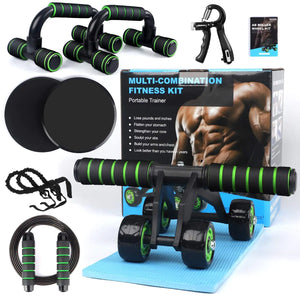
Our Equipment section has a wide range of workout equipment that can serve your needs, so feel free to give us a click and decide which of them will work for you.


